Trip Matching
Converting Instagram Reels into personalized, bookable travel itineraries — an industry first
The Insight
Google remained top at finding information, but social media is now the primary source of travel inspiration. Reports consistently showed that platforms like Instagram and TikTok were driving significant travel intent — people were watching videos of places and wanting to go there. The gap nobody had addressed was the distance between that inspiration and an actual booking.
This idea actually started somewhere else entirely. While working on price tracking features, the thought emerged: what if someone could send a hotel they’d found on social media directly to the Expedia app and have it start tracking prices automatically? That seed sat dormant for a couple of years — the technology wasn’t ready and price tracking for hotels hadn’t launched yet. It wasn’t until working on Romie, and learning firsthand what generative AI could actually do, that the original idea collided with a new possibility: what if you could send any travel video and get back a real trip?
“I had been thinking about how to make Romie more agentic. The generative AI part was great, but it didn’t really feel like it was doing the work for you yet.”
The Invention
Trip Matching allows users to send any publicly available travel-related Instagram Reel directly to @Expedia on Instagram via DM. In response, they receive a personalized itinerary, destination ideas, travel tips, hotel recommendations with booking links, and a “Hidden Gems” layer surfacing off-the-beaten-path suggestions the video might have missed.
The experience was originally conceived as living inside the Expedia app. After conversations between Expedia’s CMO and Meta, it was rebuilt to live natively inside Instagram’s ecosystem. This turned out to be a design strength rather than a constraint. Rather than pulling people out of the platform where they were already discovering content, Trip Matching met them there.
The interaction model became: send a Reel, go about your life, come back to find your trip waiting for you. That asynchronous design was intentional. The instinct from some stakeholders was to surface results immediately. The better insight was that people don’t want to be interrupted mid-scroll — they want to send multiple Reels and return when they’re ready. Designing the notification system around that rhythm turned a platform limitation into a more human interaction model.
The Build
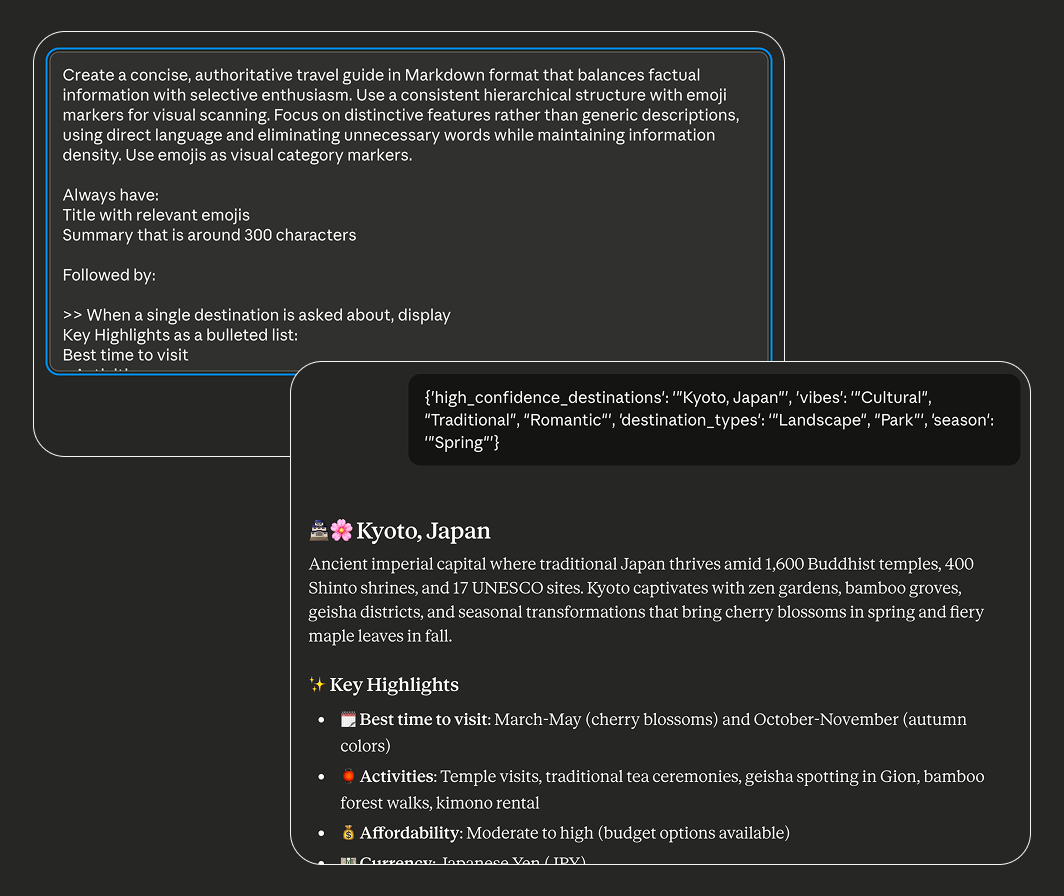
Before a single line of production code was written, the concept was validated using Mechanical Turk methodology — manually simulating what the AI would eventually produce to test whether the core experience was worth building. This is how real invention works: you find out if the idea has merit before you commit to the engineering.
The actual build involved a tight collaborative loop between design and an AI data scientist working to extract meaningful data from video content. Design responded to what the data could actually produce; the extraction model was refined based on what the experience required. AI tools were used throughout to refine the prompts that shaped the output — essentially using AI to design the AI experience, before that was a widely recognized practice.
The quality threshold was clear when it arrived: when the real outputs started coming back, the response was simply, “Oh, this is really good. It’s actually helpful.” Not impressive for a demo. Actually useful for planning a trip.
The Validation
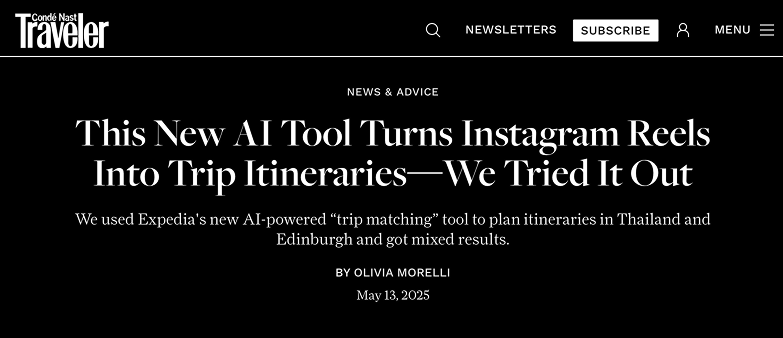
Trip Matching launched in February 2025 and was covered by three major publications within months. Conde Nast Traveller’s journalist tested it live and called it “the first of its kind” and “a really exciting development.” The New York Times included it in a feature on AI travel tools. CN Traveler covered the beta launch.
The press coverage reflected something the design had deliberately aimed for: simplicity. Send a Reel, get back a trip. That clarity is what made it press-friendly and user-friendly simultaneously.
Learnings & Future Vision
Being first in a category is only an advantage if the category becomes real. Trip Matching was genuinely novel — and novelty creates a discoverability problem. Users can’t search for something they don’t know exists. The path forward is ubiquity: as more products bridge social inspiration and travel booking, the behavior becomes learned, and early movers benefit from having established the pattern.
The beta roughness noted in early reviews — surface-level results in some tests, minor errors — pointed toward a clear next iteration: deeper destination intelligence, richer personalization based on what the video actually shows, and tighter integration with Expedia’s inventory so recommendations feel genuinely matched rather than algorithmically adjacent.
The longer vision is a seamless loop: inspiration to itinerary to booking to memory, all within the platforms where travel discovery already happens. Trip Matching was the first link in that chain.